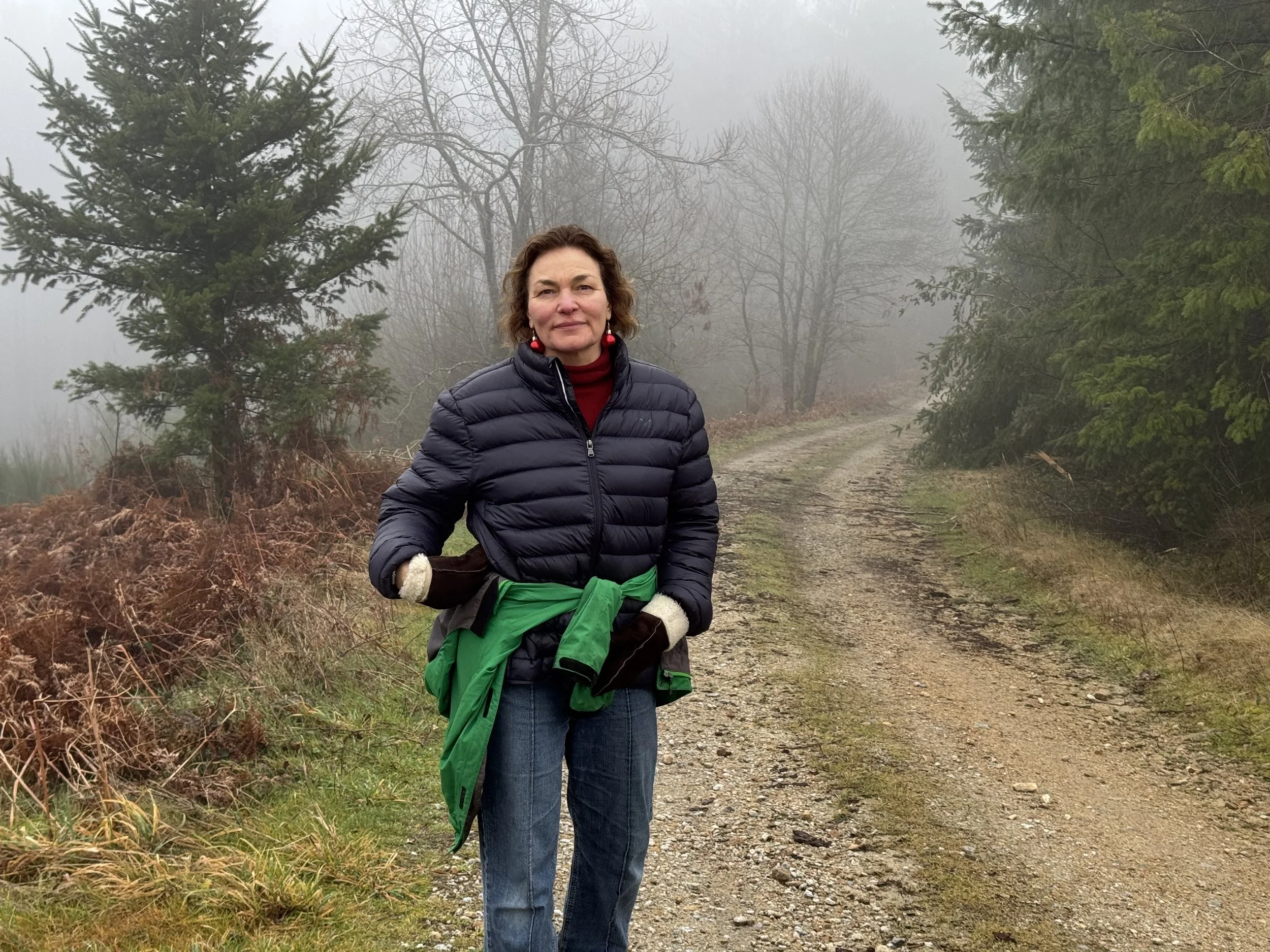
I've never really belonged to just one place.
I was raised across cultures — a third culture kid — moving between worlds, absorbing different ways of being, never quite fitting neatly into any single identity. Today I am a 60-year-old woman who has lived a full and textured life. I've raised a family, travelled the world, and eventually discovered what makes me feel truly alive.
But it took a long time to get there.
That question — who am I, underneath all of this? — would follow me through continents, through motherhood, through my own long struggle with food and my body and my sense of worth. It would eventually lead me to coaching.
But I'm getting ahead of myself.
The Anthropologist
In my late twenties I spent 16 months living in a small village in the Himalayas, doing the fieldwork for my PhD in social anthropology.
It was one of the most formative experiences of my life — and not just academically. Living inside a community so different from anything I'd known, I learned something that no classroom could have taught me. I learned how to be genuinely present with another person. How to ask questions that open things up rather than close them down. How to sit with someone's story without rushing to interpret it, fix it, or judge it. How to understand a person's world from the inside — on their own terms, not mine.
I didn't know it then, but I was learning to be a coach.
Long before I ever trained formally, the Himalayas taught me the most important thing I bring to my work: that every person is the expert on their own experience.
My job is never to tell you what to do. It's to help you hear yourself more clearly.
From Being to Performing
Before the Himalayas — before the expat years, before the coaching — there was a girl who loved to move.
I danced as a child and teenager. Ballet first, then contemporary and jazz. I was sporty, physical, alive in my body in the way children are before the world tells them otherwise. Music was woven through all of it. Moving to music felt like the most natural thing in the world — joyful, expressive, me.
And then, somewhere around 14 or 15, something shifted.
Looking back now with an anthropologist's eyes, I can see exactly what happened: I stopped being a participant in my own life and became a performance-driven observer of it. The joy of movement disappeared — replaced by something harder and colder. Appearance-driven, punishing exercise. Movement as a tool for controlling a body I'd stopped feeling at home in. And alongside it, a difficult relationship with food that would define the next few decades.
What I understand now — and what took me decades to learn — is that how we move and how we eat tell us something important about how we relate to ourselves. The punishing exercise wasn't really about fitness. The difficult relationship with food wasn't really about food. They were both expressions of something deeper: how I felt about myself. The judgment. The criticism. The conviction that I was never quite good enough.
I had stopped relating to myself with kindness. And deep down I knew it.
South East Asia — When Hope Felt Too Costly
Years later, living in South East Asia with three children under five, I found myself asking an older female friend a question that had been quietly weighing on me: is it possible to lose weight again after kids?
She said yes.
You'd think that would have been a relief. But my heart sank.
Because yes meant hope. And hope meant effort. And effort had always meant punishment — the treadmill, the restrictions, the grinding discipline that never quite worked and always left me feeling worse about myself than when I started. Underneath all of that was something even more painful: the fear of trying again and failing again. Of investing hope in myself and having it cost me.
Part of me almost wished she'd said no. At least then I could stop - and just give up on trying and I guess on myself.
For years I looked like I had it all together on the outside while feeling like a bit of a mess on the inside. Going to the gym, punishing myself on the treadmill, trying to reclaim a body I felt at home in. With little success and even less joy.
What I didn't yet understand was that the struggle was never really about my body. It was about what I'd been told I was supposed to be. I was wearing myself out trying to be good — when what I was actually hungry for was simply to feel good. To feel like myself. And in trying so hard, I'd ended up further from myself than ever.
But I didn't have the words for that yet.
West Africa — The Living Room
We moved to West Africa when my youngest was still very small.
People often imagine expat life as glamorous. And there are genuine privileges — I won't pretend otherwise. But there are also real costs that rarely get talked about. The isolation. The invisible labour of building an entire life from scratch, in an unfamiliar country, without friends or family or any of the infrastructure you took for granted at home. Everything requires navigation, vigilance, effort.
With three children under five, I was on an endless treadmill of have-tos. Getting through the days. Keeping everything going.
And one evening, sitting in our living room, it hit me.
I had a wonderful marriage. Three gorgeous children. A life most people would envy.
And I felt completely empty.
Not ungrateful — just hollow. Existing, but not thriving. Going through the motions of a life without feeling truly alive in it. I yearned for something just for me. Something that would lift me up. Something to work towards that wasn't about managing or maintaining or coping.
I just didn't know what that looked like yet.
“The numbness began to lift and the more I worked the more self aware I became. I became more assertive and began to like myself again. I realised that to be a healthy weight with a fulfilling life was far more desirable than being thin without a satisfying life.”
The Turning Point
That's when I started exploring a local gym — tentatively at first, finding a kind of quiet in moving my body that I hadn't felt in years.
And then one day I heard about taekwondo classes for children. Thinking of my oldest son, I went along to watch — but the instructor wasn't keen on observers. "Why don't you just give it a go?" he said.
So I did.
And something happened that I wasn't expecting. I didn't just tolerate it. I loved it. I got hooked — completely and immediately hooked. Not because it was easy, but because it was meaningful. Because I could see myself getting better. Because the progress was real and visible and mine. Because for the first time in longer than I could remember, I was doing something purely for the joy of it — not to fix myself, not to punish myself, not to earn anything. Just because it felt genuinely, unmistakably good.
That was my turning point.
Not a diet. Not a programme. Not a plan. An accidental invitation from an instructor who didn't want me standing on the sidelines.
In the years that followed I earned my black belt in taekwondo — in about three years, which I'm told is unusually fast. It remains one of the achievements I'm most proud of. Not because of what it says about discipline or willpower. But because of what it taught me about what becomes possible when you find something that genuinely fits who you are — when movement stops being punishment and starts being discovery.
Everything else began to fall into place. My relationship with food shifted. My relationship with my body shifted. The noise got quieter. I started to feel, slowly and imperfectly, like myself again.
“My motivation levels have gone through the roof. For a long time I had been feeling like I’ve just finished a long race. I now see glimmers of what life can be and feel motivated to attack life again. This feels great and is something I used to thrive on. I’m excited for what life can be.”
The Seed
It was still in West Africa that I began to think about retraining.
As an expat, I needed work that could travel with me — that would be meaningful wherever we ended up living. I considered becoming a taekwondo instructor. And then I discovered health and wellness coaching, and something clicked into place.
Because I realised that what had changed for me wasn't knowledge. I'd always known what I was supposed to do. What changed was something felt — an embodied experience of what it actually felt like to move with joy, to stop fighting myself, to discover what genuine self-care looked and felt like for me specifically, in my body, in my life.
And I wanted to help other women find that. Not by telling them what to do. But by helping them discover — as I had, slowly and imperfectly and sometimes accidentally — what it felt like to come home to themselves.
We moved to the Middle East. I continued taekwondo. And I enrolled in my first health and wellness coaching training.
That was the beginning.
The Essentrics Chapter
The movement arc didn't end with taekwondo.
In my 50s — on the recommendation of my mother, of all people — I discovered Essentrics. The first time I tried it, something opened up that I hadn't felt since childhood. The fluid movements, the full-body conditioning and stretching, the way it's done alongside music — it wasn't exercise. It wasn't discipline. It was something I recognised from a long time ago, before all the difficulty began. It was movement as joy. Movement as self-expression. Movement as a way of being kind to yourself rather than punishing yourself into shape.
I knew immediately it was mine.
I trained to Level 4 certification and have been teaching Essentrics for five years now. I'm a bit of a closet DJ and I love compiling the playlists. And there's something genuinely special — the psychologist Kelly McGonigal writes about this beautifully — about moving together in synchrony with other people. Something that reminds us, in our bodies rather than just our minds, that we are not alone.
Essentrics is mindful movement — you have to be fully present to follow the coordination and choreography. Which means every class is also a practice in being here, in your body, right now, with care and attention rather than judgment and criticism.
Which is, when you think about it, exactly what all of this has always been about.
Why I Do This Work
I've been a coach for 15 years now. I've sat with hundreds of women in their most honest, most exhausted, most hopeful moments. And what I see, over and over again, is the same thing I felt in that living room in West Africa, and in South East Asia when my heart sank at the word yes.
Women who are trying so hard. Women who know what they should be doing. Women who have read the books, followed the plans, started over more times than they can count — and who have quietly, protectively, stopped believing that change is really possible for them. Not because they lack willpower or intelligence. But because hope has cost them too much, too many times.
My job isn't to give anyone another plan. It's to make hope feel survivable again.
The anthropologist in me is still present in every session — curious, non-judgmental, genuinely interested in how you make sense of your world. The expat in me understands displacement and reinvention and the exhausting work of building yourself from scratch in unfamiliar territory. The woman who earned her black belt in West Africa understands that transformation doesn't have to feel like punishment — it can feel like becoming. And the Essentrics instructor in me knows, in her body not just her mind, what it feels like to move with joy again after a very long time away.
Midlife isn't a decline. It's an invitation — to shed the narratives that were never yours, to stop shrinking, to feel truly alive, possibly for the first time.
“Before my attention was always on food, whether I was under-eating or over-eating. My attention now is on living my life to the fullest and eating well to allow me to do so. I have to say I am happier now than I have been in years.”
If any of this resonates — if you recognise yourself somewhere in these pages — I'd love to have a conversation.
No pressure. No agenda. Just an honest conversation about where you are, what you're carrying, and whether working together might help.
“Jo was an excellent listener and was so accurate in reflecting back my thoughts and feelings that I often felt like she knew me better than I know myself. Coaching helped me to clarify my direction and built my confidence. I gained a much clearer picture of where I would like to be and what drives and motivates me.”
Have a question first? Get in touch here